Showing posts with label space shuttle. Show all posts

Monday, August 29, 2011

NASA Juno Tweetup: reflections

Read my previous blog entry in the "NASA Juno Tweetup" series: "Day 2 - KSC Visitor Center, Astronaut Hall of Fame and Endless BBQ"
Jump back to my first blog entry in the series:  "Preview of my report"

Countdown clock at the LC-39 Press Site

Well, this is my last post recapping my time at the NASA Tweetup for the launch of the Juno spacecraft.  It was an amazing experience stuffed into two action packed days.  It's hard to imagine that I almost wasn't able to attend due to some scheduling conflicts.  Luckily, it all worked out and I was able to take part in this once in a lifetime experience.

Hanging out with space shuttle Discovery in the VAB

As I look back, I would have to say that the tour of Kennedy Space Center and the Cape Canaveral Air Force Station was the highlight of my time there.  The sights we saw will stick with me for many years to come.  Standing next to space shuttle Discovery, looking straight up the middle of the Vehicle Assembly Building, and driving by Launch Complex 5, where the American space program started, were the real highlights for me.

Charles Bolden: shuttle astronaut, NASA Administrator and head honcho

The guest speakers, demos and launch of the Juno spacecraft were a very close second, but the tour was really something special.  The best part about the guest speakers wasn't necessarily the content of their talks, but just experiencing their passion for their work.  These were brilliant scientists, engineers and astronauts taking time out of their busy lives to share their passion with 150 Tweetup nerds in a hot tent.  Pretty inspiring people to be around.

Tweetup participants in the tent

One aspect of the Tweetup I really enjoyed was talking to other participants.  It's great to meet people that share the same interests as you, and love to get in conversations about it.  There were people from all walks of life, with many different specialties, that all shared an interest in space exploration.  The comradery on our tour bus (1A/1B), the people I sat with in the tent, my dinner companions the first night, and the folks I met at the Endless BBQ were all wonderful.  All were great people, and I hope to cultivate relationships with them via Twitter and Facebook, and maybe even see them at future NASA Tweetups.

Vehicle Assembly Building

Even though I'm not one of the "NASA is dead now that the space shuttle program is finished" people, I did take away the feeling that NASA is alive and kicking.  As Charles Bolden said, the unmanned missions are the building blocks to the higher profile manned missions of the future.  In many ways, I think the data compiled by the unmanned missions is much more exciting than the manned missions.  The Juno spacecraft will travel for five years, over 400,000,000 miles from earth, and study a planet that might give us information about how the solar system formed.  That's pretty mind blowing stuff.

It's human nature to explore earth and space.  Unfortunately, society will find money for wars in the middle of a desert on the other side of the globe before they find money for space exploration.  I guess fighting is human nature too.  Many people don't realize that space exploration has had many technological advancements as side effects.  Sure, we can just save all our money, not explore anything, not advance as a society, and die not having learned anything.  I just don't see the point in that.  Some people don't see the big picture, but I'm glad to be one of the voices that shares my enthusiasm about space exploration.

I wasn't around in the 60's, but I read that the Apollo missions unified Americans as much as WWII did.  Luckily, politicians see high profile space missions as a unifying thing, so then they will find money for NASA.  When the time comes to send humans to Mars, I hope it will be like the Apollo program all over again.  Participation by both NASA and private space companies in space exploration seems like a cost effective way to push ahead.

150 NASA Juno Tweetup participants

As you may have gathered from my last ten blog posts about the Juno Tweetup, I had a blast (pun intended).  If you have the chance to participate in a NASA Tweetup, don't pass up the opportunity.  If you don't think a Tweetup for an unmanned mission will be as exciting as one of the past shuttle Tweetups, I think you're wrong.  Heck, the GRAIL Tweetup will have Sally Ride as a guest speaker!

Even though this is my last Juno Tweetup recap post, please stay in touch by following me on Twitter and keep an eye on my blog for updates. Writing these blog posts was very fun, since I got to relive all the highlights of my two days at Kennedy Space Center.  Thanks for checking out my blog, and I hope you enjoyed reading the posts as much as I enjoyed writing them. 

See all my pictures from the NASA Juno Tweetup

Monday, August 22, 2011

NASA Juno Tweetup: day 2 - guest speakers and demos

Read my previous blog entry in the "NASA Juno Tweetup" series: "Day 1 - Vehicle Assembly Building tour"
Jump back to my first blog entry in the series:  "Preview of my report"

Charles Bolden, NASA Administrator and astronaut

After an intense first day of guest speakers and a great Kennedy Space Center/Cape Canaveral Air Force Station tour, the Juno launch day was upon us.  Day 2 of the Juno Tweetup consisted of a morning filled with more great guest speakers, some demos and interactive sessions, finally culminating with the launch of the Atlas V rocket with the Juno spacecraft.  My next blog entry will be about the Juno launch, since this post is all about our guest speakers and demos.

The NASA social media team really worked hard to put on a couple action packed days for our Tweetup.  I'm guessing that one of the most challenging aspects of setting up the Tweetup was coordinating the guest speaking portions of the two days.  Both days consisted of some very important people involved with the Juno spacecraft, the Atlas V rocket, or with NASA in general.  Trying to schedule all of these people to speak to 150 space loving nerds in a tent the day before launch and the day of launch must have been difficult.

This day's guest speaker lineup was:
and the demos we saw were from:


    Andy Aldrin from ULA

    The morning started with a talk by Andy Aldrin, who works for United Launch Alliance.  He talked about United Launch Alliance's role in the future of space exploration, and he even talked about his father.  Looking at Andy's last name, it should be pretty obvious that his father is Buzz Aldrin.  Looks like the space program runs in the blood.  When asked about growing up with Buzz Aldrin as a father, Andy said that he lived in Houston on a street where all his friends has astronaut fathers.  Hearing the way Andy talked about his father, you can tell he really admires Buzz's accomplishments.

    Waleed Abdalati, NASA Chieft Scientist

    Next up was Waleed Abdalati, who is the Chief Scientist for NASA.  He gets to set the course for NASA's scientific endeavors, and is the face of NASA in the scientific community.  He is a very funny man and an engaging public speaker.  He made a statement that many Tweetup participants took notice of (via a flurry of Tweets) stating that your job shouldn't be draining, but rather it should be energizing.  If you get home at night and you're physically drained, you body is telling you that's not the job for you.  After hearing Waleed's talk, you can tell that he's energized about his job.

    Charles Bolden, NASA Administrator and astronaut

    Our next speaker was Charles Bolden, the NASA Administrator (head honcho) talking to us about NASA's future.  He's also a former astronaut, flying on the shuttle for four missions.  In 1990 he was the pilot of STS-31, which was space shuttle Discovery (which we saw in the VAB) deploying the Hubble Space TelescopeDuring his speech, I thought to myself "this is the closest I've ever been to someone that's been in space."  A goofy thing to think, but true!  If you would like to see a video of Charles Bolden's talk to all of us in the Tweetup tent, it's posted on YouTube.

    The main theme of Charles' talk was making the point that just because the shuttle program has come to an end, that doesn't mean NASA has also come to an end.  He promoted the unmanned missions (robotic missions, as he said) as the building blocks to the manned missions of the future.  He said that without the unmanned missions, we wouldn't have the data and research to carry out the higher profile manned missions.  He also talked about either SpaceX or Orbital Sciences sending up a cargo ship to the International Space Station in early 2012.  Charles also mentioned that in early 2012, NASA will put out a request to the private space companies for proposals on their crew capable spacecraft ideas, with the goal of returning American crews (on American spacecraft) to orbit sometime between 2015 and 2017.  He also pointed out that there has been (and continues to be) Americans in space aboard the International Space Station for over 10 years.  So the U.S. is still committed to space exploration and is in the beginning of a new chapter in the space program.

    Charles made a point about the importance of Juno using solar cells to power the spacecraft, rather than nuclear power, like many other unmanned spacecraft.  When asked by a science teacher in the Tweetup crowd how he would respond to students that say they want to have his job when they grow up, Charles joked "be careful what you ask for."  I can understand that comment, in a time when funding is being cut and he constantly has to explain that the shuttle program wasn't 100% of what NASA was doing.  He wrapped up his talk by thanking us for our enthusiasm for NASA, and used a fellow space program enthusiast and previous NASA Tweetup attendee, Kate Arkless Gray, as an example of the power of using social media to promote NASA.  Kate's an avid Twitter user and space fanatic that has traveled from her home in the U.K. to experience shuttle launches and NASA Tweetups.  As he was mentioning Kate, I knew that the NASA Administrator remembering her and mentioning her name would make her year.  After his talk, Charles Bolden agreed to join all of us in front of the Vehicle Assembly Building for a group photo.

    Group photo with Charles Bolden, Waleed Abdalati and Andy Aldrin.  You can find me by looking at the water tower to the left of the VAB.  I'm in the orange shirt, about four people to the right of the water tower.


    Doug Ellison demoing "Eyes on the Solar System"

    After our group photo in front of the VAB, we headed back into the tent for the demo portion of the morning.  The first demo I attended was from the JPL's Doug EllisonDoug is a Visualization Producer at the JPL, and one of the creators of the "Eyes on the Solar System" website.  This is a very cool website that allows you to see visualizations of all the items (naturally formed and man made) in the solar system.  If you want to see Juno on its way to Jupiter, this site will show you.  How about the Cassini spacecraft orbiting Saturn?  You can see that too.  I can see myself spending lots of time on this site.

    Preston Dyches showing us some of the materials used on Juno

    I spent the rest of the demo period listening to Preston Dyches, from the JPL, talk about some of the materials used on the Juno spacecraft.  It seems the keys were finding lightweight materials that would also withstand the harsh environment in space, as well as the healthy dose of radiation that Juno will receive around Jupiter.  Preston passed around some of these materials for us to see.

    Titanium used on Juno

    One such material is titanium, that is used on Juno to protect many of the scientific instruments.  A couple of speakers on the first day also talked about the 1/2" thick casing of titanium around Juno's electronics.

    One of Juno's solar cells

    As Charles Bolden pointed out, as did other speakers on the first day, Juno is a solar powered spacecraft, rather than nuclear powered.  Preston passed around one of the solar cells that make up the large solar panels on the spacecraft.  Preson reiterated that Juno needs such large solar panels due to the low intensity level of the sun's rays at Jupiter.  Since Jupiter is so far away from the sun, compared to earth, the solar panels near Jupiter will only produce 4% of the electricity that they would if opened on earth.

    A couple other speakers we heard from during the morning were Rex Englehardt and Mike Ravine.  Rex is from NASA's Launch Services Program.  As Rex described it, he "buys rockets for a living."  The Launch Services Program is the group within NASA that contracts the private space companies, like ULA, SpaceX and Orbital Sciences, to provide launch vehicles for NASA's unmanned spacecraft.  Mike Ravine is the individual responsible for creating JunoCam, which is the camera attached to Juno.  It seems that the biggest challenge to creating JunoCam was to create a camera than will withstand the super high levels of radiation that surround Jupiter.

    Aerogel

    I'm going to jump ahead real quick (post launch), since this is a demo that should be included in this section.  After the launch, Stephanie Smith from the JPL passed around a piece of the lightest man made solid substance called Aerogel. It's essentially spun glass that looks like a block of frozen smoke. It was used as a lightweight insulation on spacecraft Stardust as well as on the Mars Rover. It was a very odd sensation holding it. Hard to describe how light it was. Even though it has the name "gel" in its title, it's a solid.  OK, now flashback to before the launch, for the last speaker of the morning.

    Bill Nye, The Science Guy

    Our final speaker was a big crowd favorite:  Bill Nye, The Science Guy.  He was at Kennedy Space Center to watch the launch, and agreed to talk to all of us in the Tweetup tent.  He's a very enthusiastic guy, and is exactly like you've seen him on TV.  If you would like to watch his talk to all of us in the Tweetup tent, it's posted on YouTube.  Bill talked about the importance of teaching children math and science, his enthusiasm for the Juno mission and future NASA missions, and talked quite a bit about The Planetary Society, of which he's executive director.  He was in a room full of 150 space nerds, so he was in his element.  He took plenty of questions from the audience, and even stuck around after his talk and came back after the launch to take pictures with us.  He was a big crowd favorite.

    After Bill Nye's talk wrapped up, we had about 30 minutes until the launch of the Atlas V rocket with the Juno spacecraft.  Well, it turned out to be more than 30 minutes until launch, but you can read all about that in my next blog entry detailing the Juno launch.

    Read my next blog entry in the "NASA Juno Tweetup" series:  "Day 2 - Juno launch"
    See all my pictures from the NASA Juno Tweetup

    Friday, August 19, 2011

    NASA Juno Tweetup: day 1 - Vehicle Assembly Building tour

    Read my previous blog entry in the "NASA Juno Tweetup" series: "Day 1 - Launch Complex 41 tour"
    Jump back to my first blog entry in the series:  "Preview of my report"


    Our final stop on our tour of Kennedy Space Center and the Cape Canaveral Air Force Station was the Vehicle Assembly Building.  As I wrote about in previous blog entries, our visits to Launch Complex 17, the Atlas V Spaceflight Operations Center, Launch Complex 41, and a drive-by of Launch Complex 39A were all amazing sights, but the VAB was really the stop that we were all looking forward to.  This was especially due to the fact that many of us knew about the surprise that was waiting for us inside the iconic building.  Bus 1B's tour guide, who's name completely escapes me, worked for many years in the VAB, so I'm able to regurgitate many VAB facts that he told us.


    The Vehicle Assembly Building is a building that is rarely visited by those of us that don't work for the space program.  Including it on our tour was a treat that we all were just giddy about.  Built in 1966, the VAB was constructed to vertically assemble the 363' tall Saturn V rocket and capsule that transported humans 235,000 miles away, to the moon.  All of the separate pieces of the massive rocket would be brought into the VAB, hoisted with a crane on the ceiling, and placed into position on the Mobile Launcher Platform.  The support structure (tower) would be attached to the Mobile Launcher Platform, and the whole package (rocket, MLP and support structure) would be moved by the Crawler from the VAB to Launch Complex 39A or 39B.  The assembly of the space shuttle's orbiter, external fuel tank, and solid rocket boosters would follow the same idea as the assembly of the Saturn V.

    The view from my parking spot each morning

    The volume of the VAB equals almost four Empire State Buildings. The building is so large that without proper cooling and air handling, a rain cloud can form inside it up along the ceiling. It also takes the building about 12 hours to adjust to temperature changes outside, due to the massive volume of air inside it.

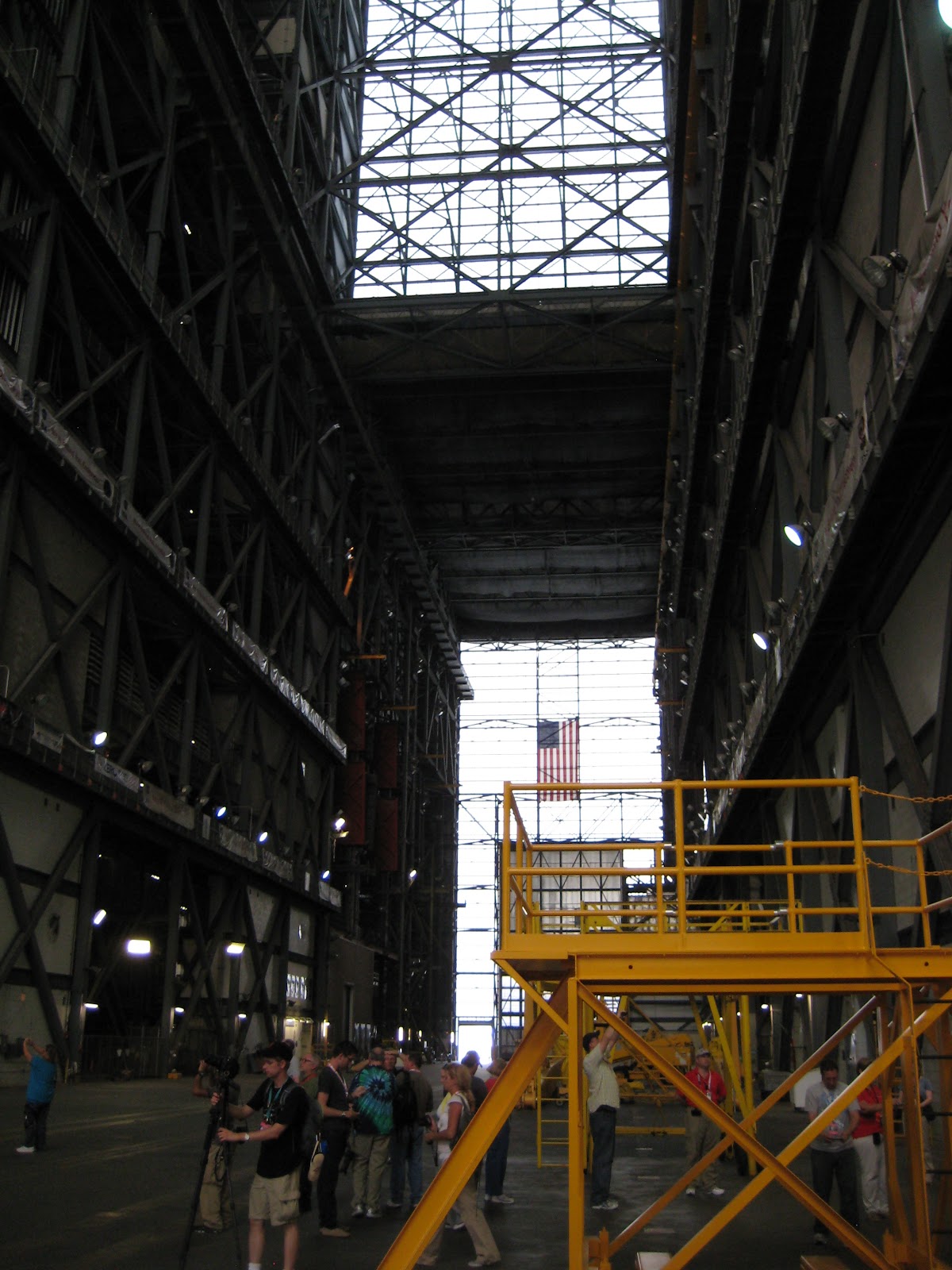
    Facing north, looking down the "transfer aisle" inside the VAB

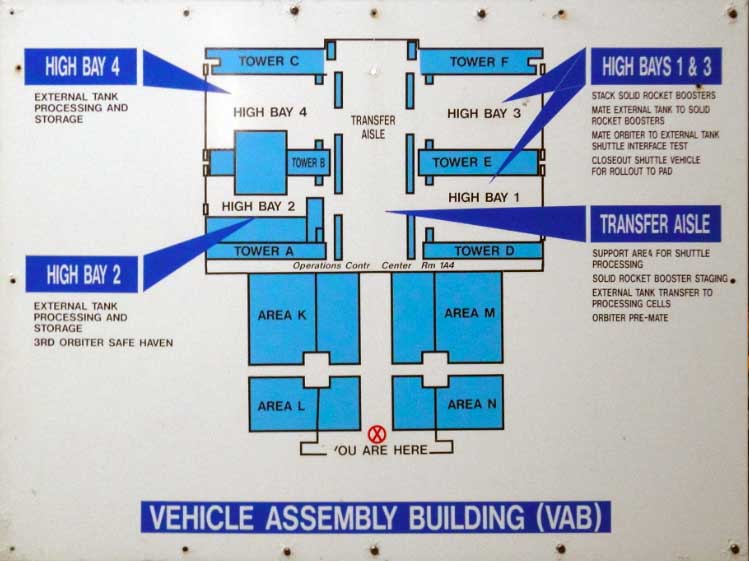
    As we entered the VAB, I snapped the photo you see above.  This photo doesn't even begin to represent the sheer size of this building.  Known to be the tallest one story building in the world, you can look up in the transfer aisle and see the ceiling 526' above you.  We entered the VAB on the south side, so the view you're looking at above is facing north.  There are four "high bays" that surround the transfer aisle, with service structures that surround each high bay.  Peter Crow has a good picture of the VAB floor plan on his blog.

    Looking straight up in the transfer aisle at the crane

    Looking at the picture above, you can see the crane that is on the ceiling of the transfer aisle.  The assembly process would start with the component (shuttle orbiter, Saturn V lower stage, external fuel tank, etc.) trucked in horizontally and parked in the transfer aisle.  (The VAB is right next to the Orbiter Processing Facilities, which are the shuttle storage hangers, so this wasn't a long trip for the orbiters.)  The crane you see above would lift the pieces up, and move them laterally into one of the high bays to be mated with the other pieces on the Mobile Launcher Platform.  After assembly, the bay doors on the east side of the VAB would open.  You can see those doors in the very first picture of this blog entry, next to my right shoulder.  Those doors take 45 minutes to completely open or close.  The space shuttle only needed the bay doors opened halfway up, but the Saturn V needed them open all the way to the roof, showing the height difference between the two.  After the bay doors opened, the Crawler would vertically move the Saturn V or shuttle down the Crawlerway along Saturn Causeway, down to one of the two Launch Complex 39 pads.  There are some great pictures of the shuttle assembly process inside the VAB on this Boston.com page

    The surprise is finally revealed

    As we made our way down the transfer aisle, we finally came to the surprise waiting for us at the bottom of high bay 4:  Space Shuttle Discovery.  One of the many space enthusiasts I follow on Twitter had just posted pictures of a shuttle in the VAB, so I was really hoping that it was still there, and luckily it was.  Since the shuttle program came to an end less than a month prior to my KSC visit with the STS-135 mission (Atlantis), the shuttles were being processed for donation to museums.  Discovery is going to the Smithsonian Air & Space Museum in DC, Endeavour is being donated to the California Science Center and Atlantis will remain at the Kennedy Space Center Visitor Complex.

    Discovery

    It was amazing to stand 20 feet away from such an important piece of technology.  Discovery has left earth 39 times, logging 148 million miles traveled and, when totaled up, spent almost a full year orbiting earth.  I was star struck (pun intended) as I stood next to this machine.  I stood there and told myself that this is a once in a lifetime experience. I'll never have another chance to stand next to a space shuttle inside the Vehicle Assembly Building.  I realized that this would be one of those moments that I would remember for the rest of my life.  My kids and grand kids will roll their eyes every time I tell them about the day I stood next to Discovery in the Vehicle Assembly Building.


    As you can see, part of the nose of Discovery has been removed.  Technicians are in the middle of decommissioning all three remaining orbiters to remove any potentially harmful components.  Endeavour and Atlantis were next door in the hangers at the Orbiter Processing Facility receiving the same treatment.  As sad as it is to see the shuttle era come to an end, this simply means that NASA and private space companies are ready to move into a new era of space exploration.  The space shuttle has been flying since the 1980's, so it's time for technological advancement to take over and push the space program ahead.

    Facing south, looking back down the transfer aisle

    Looking back down the transfer aisle, you can start to get an idea of the immense size of the VAB by looking at the photo above, with people in the shot for reference.  The VAB currently sits under utilized, as NASA makes important decisions as to the future of space exploration.  The VAB was set to become the home to the Ares rocket assembly, but after the Constellation Program was canceled, NASA's next human launch vehicle and spacecraft are still being determined.

    Discovery staring us down

    As I walked away from high bay 4, I took one last look at Discovery.  I really didn't want to go, and was one of the last people to walk away from the shuttle.  I was just trying to wrap my head around the amazing history this machine had made, and the incredible places it had been.

    Wall of shuttle technician signatures

    As we were walking back down the transfer aisle toward the exit, we passed this wall, with thousands of signatures of many of the technicians that worked on the space shuttle program.  It was amazing to see how many people it took to maintain and launch the shuttle fleet.

    We all piled back into bus 1B, which returned us to our Tweetup tent at the Launch Complex 39 Press Site.  This marked the end of day one, and what an intense day it was!  I had a nice dinner with two fellow Tweetup attendees that night, Amanda Marron and Ranz Adams, and I think we had a really hard time wrapping our heads around what we had experienced on day one.  Amazing guest speakers and a truly unforgettable tour of America's busiest spaceport.  Early to bed, since tomorrow is launch day for the Atlas V rocket and the Juno spacecraft.

    Read my next blog entry in the "NASA Juno Tweetup" series:  "Day 2 - guest speakers and demos"
    See all my pictures from the NASA Juno Tweetup